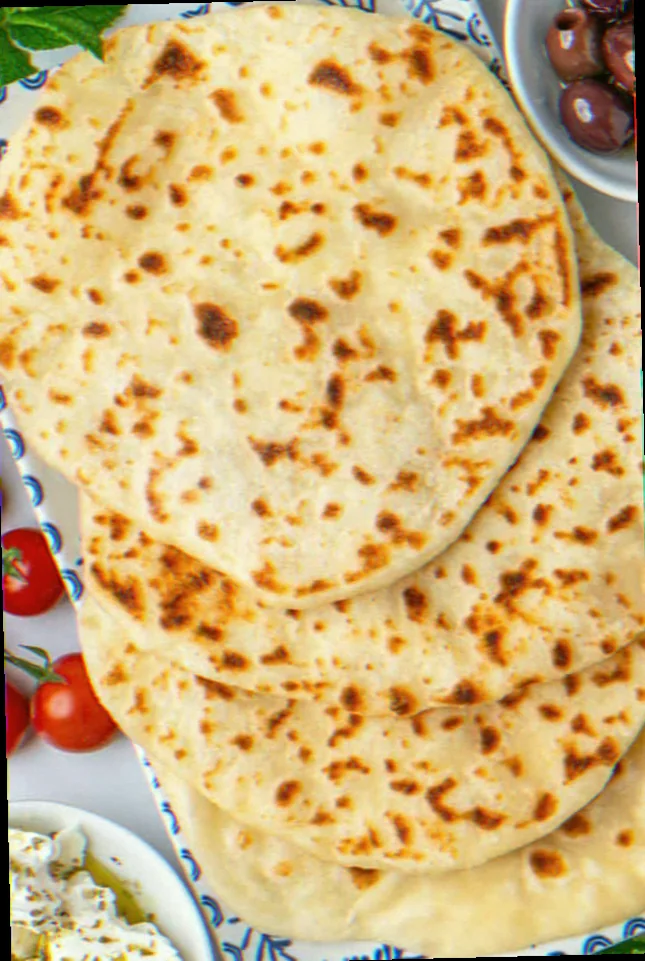
Yogurt flatbread, or bazlama as it's known in Turkey, achieves its uniquely soft and slightly tangy character through a fascinating interplay of lactic acid and gluten development. The yogurt introduces acidity that tenderizes the gluten network, preventing toughness, while also contributing a subtle flavour complexity. This baked good, originating in Anatolia, relies on a careful balance of ingredients and technique to deliver a pillowy texture and satisfying chew.
Complete Recipe Overview
| Property | Detail |
|---|---|
| Dish entity | Yogurt Flatbread (Bazlama) |
| Cuisine origin | Turkish (Anatolian) |
| Defining technique | Pan-frying and Baking |
| Hero ingredients | Yogurt, Flour, Yeast |
| Critical ratio | Liquid (Yogurt + Water):Flour (approximately 60:40 by weight) |
| Prep time | 20 minutes + 1 hour proofing |
| Cook time | 2-3 minutes per side at 200°C, then 5-7 minutes baking |
| Rest / chill time | 1 hour proofing |
| Yield | 8 flatbreads |
| Difficulty | Medium - requires understanding of dough handling and temperature control for optimal yeast activity. |
Ingredients: Quantities, Roles, and Critical Ratios
The success of yogurt flatbread hinges on the harmonious interaction between the flour, yogurt, and yeast. The yogurt provides both moisture and acidity, crucial for a tender crumb. Flour provides the structure, and yeast creates the airy texture. The liquid-to-flour ratio is paramount; too little liquid results in a dense, tough flatbread, while too much makes the dough unmanageable. A 60:40 ratio (liquid:flour by weight) is the sweet spot, allowing for sufficient gluten development without excessive toughness.
- Plain Yogurt (full-fat) - 250g - Role: Tenderizes gluten, adds tang, provides moisture.
- All-Purpose Flour - 350g - Role: Provides structure, forms gluten network.
- Instant Dry Yeast - 7g - Role: Leavening agent, creates air pockets.
- Warm Water - 60ml - Role: Activates yeast, adjusts dough hydration.
- Olive Oil - 20ml - Role: Adds flavour, improves dough elasticity.
- Salt - 8g - Role: Enhances flavour, controls yeast activity.
- Baking Powder - 1 tsp (4g) - Role: Provides additional lift and lightness.
The Science of Yogurt Fermentation
The defining characteristic of yogurt flatbread is, of course, the yogurt itself. Yogurt is produced through the bacterial fermentation of milk, primarily by Streptococcus thermophilus and Lactobacillus bulgaricus. These bacteria consume lactose (milk sugar) and produce lactic acid as a byproduct. This lactic acid lowers the pH of the dough, which has several important effects. Firstly, it weakens the gluten network, resulting in a more tender texture. Secondly, it inhibits the activity of enzymes that can cause staling. Finally, the lactic acid contributes to the characteristic tangy flavour of the flatbread. The full-fat content of the yogurt also plays a role, providing richness and contributing to a softer crumb structure. The fat interferes with gluten strand formation, further enhancing tenderness.
Method: Pan-frying and Baking at Every Critical Stage
This method combines the initial heat of pan-frying to create a slight crust and then finishes in the oven to ensure the flatbread is cooked through and develops a light, airy interior.
- Combine - Dough Formation: In a large bowl, combine yogurt, flour, yeast, warm water, olive oil, salt, and baking powder. Mix until a shaggy dough forms. Knead for 5-7 minutes until smooth and elastic.
- Proof - First Rise: Place the dough in a lightly oiled bowl, turning to coat. Cover and let rise in a warm place for 1 hour, or until doubled in size.
- Divide - Shaping: Gently punch down the dough and divide it into 8 equal pieces. Roll each piece into a ball.
- Roll - Flattening: On a lightly floured surface, roll each ball into a roughly 15-20cm diameter circle, about 0.5cm thick. Critical control point 1: Avoid overworking the dough during rolling, as this can develop too much gluten and result in a tough flatbread. If the dough springs back, let it rest for 5 minutes before continuing.
- Pan-fry - Initial Cook: Heat a dry cast-iron skillet or heavy-bottomed pan over medium-high heat. Place one flatbread in the hot pan and cook for 1-2 minutes per side, until lightly browned and slightly puffed.
- Bake - Final Cook: Transfer the partially cooked flatbread to a baking sheet lined with parchment paper. Critical control point 2: Ensure the oven is preheated to 200°C. If the oven isn't hot enough, the flatbreads won't puff up properly.
- Bake - Completion: Bake for 5-7 minutes, or until golden brown and puffed up.
- Rest - Cooling: Transfer the baked flatbreads to a wire rack to cool slightly.
- Plate and serve: Stack the flatbreads, slightly overlapping, to showcase their soft texture and golden colour.
Cultural and Historical Context of Turkish Cuisine
Yogurt flatbread, or bazlama, has deep roots in Anatolian cuisine, the region encompassing modern-day Turkey. Historically, it was a staple food for nomadic communities and rural populations, as it required simple ingredients and could be cooked over an open fire. The use of yogurt in breadmaking is a hallmark of Turkish culinary tradition, reflecting the importance of dairy farming in the region. Bazlama was often baked on a sac, a convex metal griddle, and served with cheese, honey, or simply enjoyed on its own.
Variations Across Regional Turkish Cuisine
- Karadeniz (Black Sea Region) Bazlama: This version often includes cornmeal in the dough, giving it a slightly coarser texture and a distinctive flavour.
- Inner Anatolian Bazlama: In central Turkey, bazlama is sometimes made with a higher proportion of yogurt, resulting in an even softer and tangier flatbread.
- Vegan Adaptation: Substitute the yogurt with a plant-based yogurt alternative (soy or coconut-based) and ensure it has a similar acidity level. The texture may be slightly different, but the flavour profile can be maintained.
- Modern Adaptation: Incorporating herbs like dill or parsley into the dough adds a fresh, aromatic dimension to the flatbread.
Storage, Freezing, and Reheating Yogurt Flatbread
Yogurt flatbread is best enjoyed fresh, but leftovers can be stored. At room temperature, they will become stale within a few hours. In the refrigerator, store in an airtight container for up to 3 days. They will lose some of their softness. To reheat, lightly mist with water and warm in a dry skillet over medium heat for 30-60 seconds per side. For freezer storage, wrap individually in plastic wrap, then place in a freezer bag for up to 2 months. Reheat directly from frozen in a dry skillet or oven at 180°C for 5-7 minutes.
Pairing Yogurt Flatbread: Sides, Sauces, and Drinks
Yogurt flatbread pairs beautifully with hearty stews and grilled meats. A side of cacık (Turkish yogurt dip with cucumber and mint) provides a cooling contrast to the warm flatbread. For a drink pairing, a dry rosé wine complements the tanginess of the yogurt and the subtle sweetness of the bread. Alternatively, a light-bodied Turkish tea, such as çay, offers a refreshing and traditional accompaniment.
Answers to the Most-Searched Questions About Yogurt flatbread recipe
What temperature should Yogurt flatbread be cooked at - and how do I know it's done?
The flatbread should be cooked at 200°C. It's done when it's golden brown and puffed up, and sounds hollow when tapped.
What is the difference between Yogurt flatbread recipe and pita bread?
Pita bread typically contains no yogurt and relies solely on yeast for leavening, resulting in a pocket formation. Yogurt flatbread uses yogurt to tenderize the dough and create a softer, more pliable texture without a pocket.
Can Yogurt flatbread recipe be made in advance, and does it freeze well?
The dough can be made a day in advance and refrigerated after the first rise. The baked flatbreads can be frozen for up to 2 months, but they will lose some of their initial softness upon thawing.