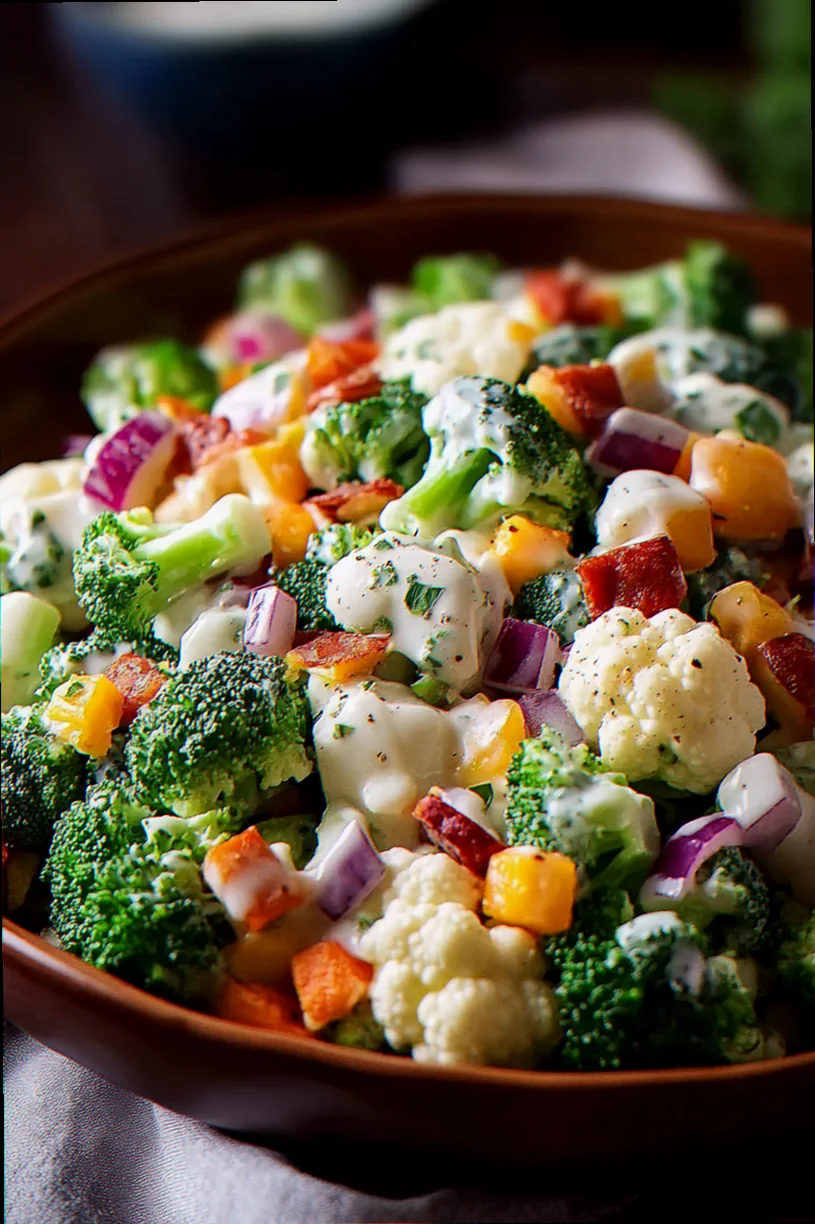
The culinary magic of a well-crafted salad often lies in the interplay of textures and the balance of flavors, a principle perfectly embodied in the Broccoli and Cauliflower Salad. At its heart, this dish hinges on the crisp, slightly resistant crunch of raw or lightly blanched cruciferous vegetables-a result of their rigid cell walls and the presence of glucosinolates that contribute their characteristic pungency. This firm texture provides a vital counterpoint to a rich, emulsified dressing, creating a symphony of sensory experiences that makes this American potluck staple so enduringly popular.
Complete Recipe Overview
| Property | Detail |
|---|---|
| Dish entity | Broccoli and Cauliflower Salad |
| Cuisine origin | American (Potluck/Picnic) |
| Defining technique | Precise Chopping and Dressing Emulsification |
| Hero ingredients | Broccoli Florets, Cauliflower Florets, Creamy Dressing (Mayonnaise-based) |
| Critical ratio | Vegetable to Dressing (approx. 4:1 by volume) |
| Prep time | 20 minutes |
| Cook time | 10 minutes (for bacon) + optional 2 minutes (for blanching) |
| Rest / chill time | 60 minutes (minimum) |
| Yield | 6-8 servings |
| Difficulty | Easy - requires precise chopping for consistent texture and simple dressing assembly. |
Ingredients: Quantities, Roles, and Critical Ratios
The structural logic of this salad relies on a foundation of uniformly chopped, crisp vegetables coated in a balanced, tangy-sweet creamy dressing. The critical ratio of vegetable to dressing, ideally around 4:1 by volume, ensures that the florets are thoroughly coated without becoming swimming in excess dressing, preserving their inherent crunch. The sweet-acid balance in the dressing is also paramount, cutting through the richness of the mayonnaise and bacon while complementing the slight bitterness of the brassicas.
- Broccoli florets - 450 g (approximately 1 large head) - Role: Provides vibrant color, distinct texture, and a subtly bitter, earthy flavor.
- Cauliflower florets - 450 g (approximately 1 medium head) - Role: Offers a milder, slightly sweeter contrast to broccoli with a similar crisp texture.
- Bacon - 150 g - Role: Delivers intense umami, smoky flavor, and crispy texture, contrasting the fresh vegetables.
- Red onion - 60 g (about ½ small onion), finely diced - Role: Adds pungent allium bite and a pop of color.
- Dried cranberries or golden raisins - 80 g - Role: Introduces bursts of sweetness and chewiness, balancing savory elements.
- Sunflower seeds or pepitas - 60 g - Role: Contributes nutty flavor and an additional layer of crunch.
- Mayonnaise - 240 ml (1 cup) - Role: Forms the creamy, binding base of the dressing, providing richness and a smooth texture.
- Apple cider vinegar - 30 ml (2 tablespoons) - Role: Adds essential acidity to brighten the dressing and cut through the richness.
- Granulated sugar - 15 g (1 tablespoon) - Role: Balances the acidity of the vinegar and the bitterness of the vegetables, enhancing overall flavor harmony.
- Dijon mustard - 5 g (1 teaspoon) - Role: Adds a subtle tang and helps emulsify the dressing.
- Salt - 5 g (1 teaspoon), or to taste - Role: Essential seasoning, enhances all other flavors.
- Freshly ground black pepper - 2 g (½ teaspoon), or to taste - Role: Adds aromatic warmth and a touch of subtle heat.
The Science of Cruciferous Crunch: Broccoli and Cauliflower
Broccoli and cauliflower, both members of the Brassica oleracea species, are botanically fascinating. Their defining characteristic in this salad is their crisp-tender texture, which comes from their robust cellular structure. The cell walls of these vegetables are composed primarily of cellulose, hemicellulose, and pectin, providing significant structural integrity. When raw, these components are firm, giving the florets their satisfying crunch. The slight bitterness associated with these vegetables is due to compounds called glucosinolates. When the cell walls are broken-through chopping or chewing-an enzyme called myrosinase is released, which hydrolyzes glucosinolates into various pungent and health-beneficial compounds like isothiocyanates (e.g., sulforaphane). This enzymatic reaction is what gives raw broccoli and cauliflower their characteristic "bite." Light blanching (brief immersion in boiling water followed by an ice bath) can be employed to slightly soften the cell walls, making the vegetables more tender and easier to digest, while still preserving much of their crispness. Crucially, blanching also denatures the myrosinase enzyme, which can temper some of the more intense pungent flavors, making the salad appealing to a wider palate. Over-blanching, however, would cause excessive softening and waterlogging, compromising the desirable crunch and diluting flavor.
Method: Precise Chopping and Emulsification at Every Critical Stage
This method is optimized for achieving uniform texture and a perfectly coated, flavorful salad, ensuring each bite offers a balanced experience.
- Prepare - Bacon: Render 150 g of bacon in a pan over medium heat until uniformly crispy and golden brown. This usually takes about 8-10 minutes. Remove the bacon, drain on paper towels, and once cool, crumble into small pieces. Reserve the rendered fat for other uses if desired.
- Chop - Vegetables: Wash and thoroughly dry 450 g broccoli and 450 g cauliflower. Trim away thick stems. Critical control point 1 - Uniform Florets: Cut the broccoli and cauliflower into very small, bite-sized florets, aiming for pieces roughly 1-1.5 cm in diameter. This uniformity is crucial for even coating by the dressing and a consistent texture in every spoonful. If florets are too large, they won't absorb the dressing well; if too small, they can become mushy.
- Dice - Red Onion: Finely dice 60 g of red onion. The smaller the dice, the better it integrates into the salad without overpowering.
- Combine - Dressing Ingredients: In a medium bowl, whisk together 240 ml mayonnaise, 30 ml apple cider vinegar, 15 g granulated sugar, 5 g Dijon mustard, 5 g salt, and 2 g black pepper until completely smooth and the sugar is dissolved. Critical control point 2 - Dressing Consistency: Ensure the dressing is well-emulsified and free of sugar granules. Taste and adjust for sweet/acid balance - it should be tangy, slightly sweet, and creamy. If it tastes too flat, add a pinch more salt or a tiny splash more vinegar. If too acidic, add a touch more sugar.
- Assemble - Salad Components: In a large mixing bowl, combine the chopped broccoli and cauliflower florets, diced red onion, dried cranberries, and sunflower seeds.
- Dress - Salad: Pour the prepared dressing over the vegetable mixture. Using a large spatula or your hands, gently toss all ingredients until the vegetables are uniformly coated with the dressing. Ensure no dry spots remain, but avoid mashing the florets.
- Rest / set / cool - 60 minutes minimum: Cover the bowl with plastic wrap and refrigerate for at least 1 hour. This step is non-negotiable as it allows the flavors to meld, the dressing to slightly soften the raw vegetables, and the salad to chill thoroughly, resulting in a more cohesive and refreshing dish. Skipping this step will result in a less flavorful and integrated salad.
- Plate and serve: Before serving, give the salad a final gentle toss. Garnish with a sprinkle of additional crumbled bacon or fresh parsley if desired. Serve chilled, showcasing its vibrant colors and textural contrasts.
Cultural and Historical Context of American Potluck Salads
The Broccoli and Cauliflower Salad, as we know it today, finds its roots deeply embedded in the culinary traditions of mid-20th century American cuisine, particularly in the context of potlucks, church picnics, and backyard barbecues. While its exact genesis is difficult to pinpoint, creamy, mayonnaise-based salads became incredibly popular during this era, offering a practical and crowd-pleasing side dish that could be prepared in advance and transported easily. This salad is a natural evolution from other popular American creamy salads like coleslaw and potato salad, adapting fresh, crunchy brassicas to a similar dressing profile. It became a staple in many Southern and Midwestern households, valued for its robust flavor, satisfying texture, and ability to feed a large gathering. The addition of sweet dried fruits and savory bacon provides a complex flavor profile that appeals to a wide range of tastes, making it a reliable and beloved contribution to communal meals.
Variations Across Regional and Dietary Entities
- Southern American Variation (with Cheddar Cheese): Many versions originating from the American South include 100 g of shredded sharp cheddar cheese, often added along with the bacon and seeds. This adds a salty, tangy, and rich dairy note, making the salad even heartier and more indulgent.
- California Fresh Twist (with Avocado and Lighter Dressing): A more contemporary and health-conscious adaptation might swap out some of the mayonnaise for Greek